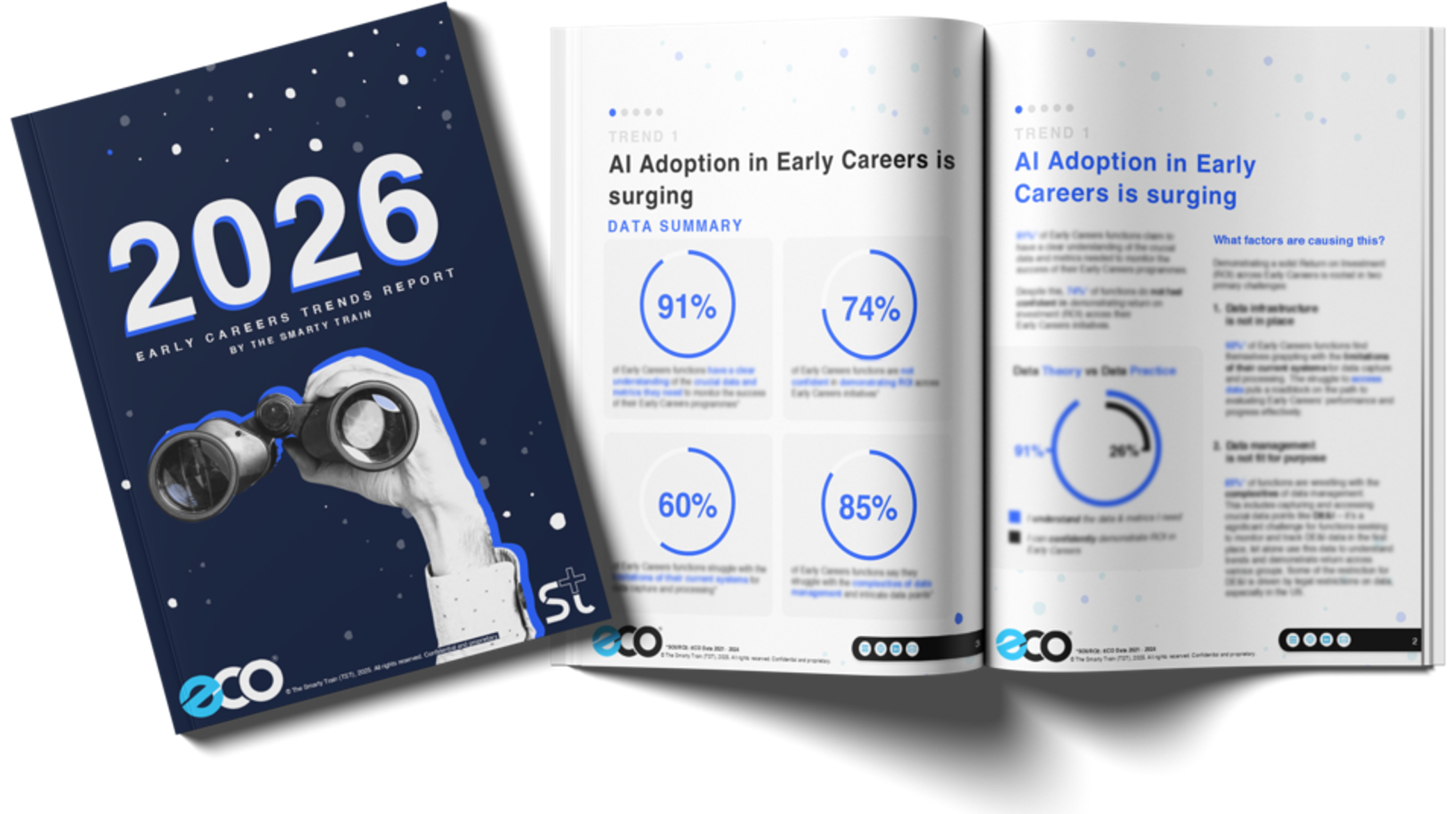
2026 Early Careers
Trends Report
Key Early Careers trends for 2026.
2026 marks a decisive moment for Early Careers. This year’s findings show that across industries, the function sits at a crossroads between cost efficiency and long-term investment. Budgets are tightening, automation is accelerating, and leaders are under growing pressure to prove that every initiative contributes measurable value.
Backed by brand-new and exclusive ECO data, the 2026 Early Careers Trends Report provides a forward-looking analysis of key trends and opportunities impacting Early Careers functions in 2026 and beyond.
Read the report now to dive into the full data, explore the recommendations, and discover how best-practice organisations are rethinking their Early Careers strategies over the coming year.
Get the reportAI use in Early Careers has surged 50% in just one year.
Our research has shown AI implementation in Early Careers functions has brought speed and scale, but not without consequences.
Read the full report to discover the benefits and drawbacks noted by pioneering AI-enabled Early Careers functions, and targeted steps you can take to responsibly integrate AI into your Early Careers strategy.
Get the report

56% of Early Careers stakeholders now see ‘Embracing Change’ as the top human skill, up from 41% since 2024.
Organisations are under growing pressure to hire talent that can adapt, collaborate, and work through uncertainty. Yet while the importance of human skills has never been clearer, many Early Careers functions still lack the frameworks needed to define, measure, or develop them effectively.
Read the full report to gain insight into the barriers organisations are overcoming to ensure their Early Careers cohorts are equipped with the right skills in 2026.
Get the reportStakeholder support for Early Careers functions has fallen 68% since the start of 2024.
Internal support for Early Careers has fallen sharply. The challenge for today’s Early Careers leaders? Rebuilding trust and investment from within.
Read the full report to learn the factors impacting Early Careers stakeholder misalignment — and the tangible benefits brought to organisations who get stakeholder management right.
Get the report

Organisations with the highest three-year retention rates spend nearly 4× longer on inductions than those with below-average retention.
At a time where Early Careers functions must demonstrate clear return on investment, our data reveals that overinvestment in inductions and onboarding are increasingly providing long-term value.
Read the full report to discover how onboarding is evolving beyond an administrative process to a strategic Early Careers investment.
Get the report50% of organisations cited ‘Post-Programme Transition’ as their biggest retention challenge.
ECO data shows that the strongest predictor of long-term retention is not salary or training budget alone, but the extent to which organisations make their Early Careers hires feel supported, recognised, and part of something bigger.
Read the full report to discover how organisations are adapting their strategies to better support, train and retain their Early Careers talent.
Get the report
Powered by ECO.

Get the
full story.